
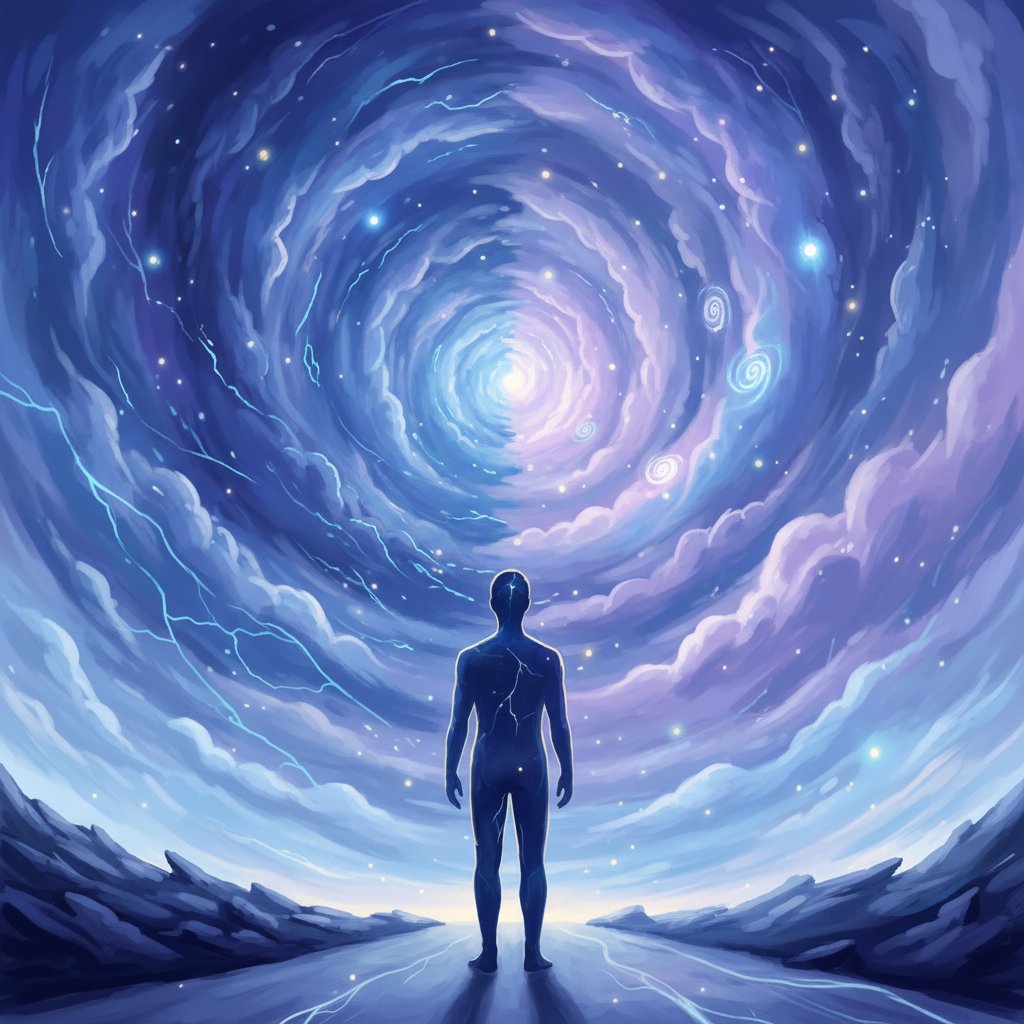
Your dreams have always been a mirror. But in 2026, that mirror reflects a world moving faster than the human nervous system was designed to handle. AI is reshaping careers overnight. Economic forecasts shift weekly. Climate headlines grow more alarming. Social media delivers an endless scroll of crisis. And every night, your sleeping brain tries to make sense of it all — often through dreams that leave you more exhausted than when you fell asleep.
This guide connects the dots between the specific anxieties of our current moment and the stress dreams they produce, giving you a framework to decode your nightscape and reclaim restful sleep.
What Are Stress Dreams?
Stress dreams are emotionally intense dream experiences driven by unresolved anxiety, worry, or overwhelm from waking life. They differ from nightmares in an important way: nightmares present external threats (monsters, attackers, disasters), while stress dreams recreate internal emotional states — the feeling of being unprepared, late, lost, or exposed.
Your brain doesn't randomly generate these scenarios. Research published in Frontiers in Psychology shows that dream content directly correlates with waking emotional concerns. Stress dreams are your subconscious processing what your conscious mind either can't or won't address during the day.
Why 2026 Is a Perfect Storm for Stress Dreams
Several converging pressures make our current moment uniquely dream-disrupting:
AI and Job Displacement Anxiety
The rapid deployment of AI across industries has created a pervasive sense of professional insecurity. Even people whose jobs aren't immediately threatened absorb ambient anxiety through news cycles and social conversations. This manifests in dreams about being replaced, becoming irrelevant, or showing up to work to find your role no longer exists.
Economic Uncertainty
Inflation aftershocks, housing market instability, and shifting job markets create a baseline financial unease. The American Institute of Stress reports that financial concerns remain the number one stressor for adults — and financial stress dreams (being unable to pay, losing your home, watching money disappear) have intensified accordingly.
Climate Anxiety and Eco-Dread
Climate anxiety — sometimes called "eco-anxiety" — has emerged as a significant mental health factor, particularly among younger adults. Dreams about floods, fires, collapsing landscapes, and environmental catastrophe often trace back to this diffuse, chronic worry about the planet's future.
Social Media Overwhelm
The constant exposure to curated highlight reels, outrage cycles, and information overload fragments attention and erodes the psychological rest that healthy sleep requires. Dreams about being watched, judged, or unable to keep up frequently reflect social media's impact on self-perception.
Post-Pandemic Residual Stress
The psychological aftershocks of the pandemic continue to ripple through dream content years later. Research from the University of Montreal documented a significant increase in threat-themed dreams during and after the pandemic — a pattern that persists for many people.
Your Stress Dream Archetype: A Decoding Framework
Most stress dreams fall into recognizable patterns. Identifying yours reveals what your waking mind is struggling with:
The Chase Dream — Avoidance
You dream: Being pursued by an unknown figure, animal, or force you can't see. What it reveals: You're running from something in waking life — a difficult conversation, a decision you've been postponing, a truth you're not ready to face. The pursuer often represents the avoided issue itself. 2026 connection: Many people report chase dreams intensifying during career uncertainty, where the "thing chasing you" is the fear of obsolescence.
The Exam Dream — Impostor Syndrome
You dream: Taking a test you didn't study for, in a subject you don't recognize, in a room you can't find. What it reveals: Deep performance anxiety and fear of being exposed as inadequate. This dream persists decades after school because the feeling of being evaluated never fully leaves. 2026 connection: Common among professionals navigating AI-augmented workplaces where the "test" is constantly evolving and the study material changes daily.
The Falling Dream — Loss of Control
You dream: Losing your footing, plunging from heights, or the ground disappearing beneath you. What it reveals: A fundamental sense that your stability is threatened. Something you relied on — a relationship, financial security, career trajectory — feels precarious. 2026 connection: Economic instability and rapid change create the perfect conditions for falling dreams.
The Late Dream — Fear of Missing Out
You dream: Running desperately to catch a train, plane, or appointment you're already missing. What it reveals: Anxiety about time, opportunity, and keeping pace. You may feel life is moving faster than your ability to participate in it. 2026 connection: The accelerating pace of technological and cultural change amplifies this archetype significantly.
The Trapped Dream — Powerlessness
You dream: Being locked in a room, stuck in an elevator, or unable to move or speak. What it reveals: Feeling constrained by circumstances beyond your control — a job, a relationship, a financial situation, or systemic forces. 2026 connection: Climate anxiety and institutional distrust often manifest as entrapment dreams where escape feels structurally impossible.
Practical Strategies for Managing Stress Dreams
Before Sleep
- The 30-minute buffer: Stop consuming news, social media, and work communications at least 30 minutes before bed. Your brain needs transition time between input mode and rest mode
- Worry journal dump: Write down three specific concerns on paper. Research shows that externalizing worries before sleep reduces their appearance in dreams by giving the brain a sense of "task completed"
- Body-based calming: Progressive muscle relaxation or four-count breathing (inhale 4, hold 4, exhale 4, hold 4) activates the parasympathetic nervous system and primes the brain for restorative sleep
- Limit stimulants: Caffeine, alcohol, and heavy meals within three hours of bedtime all increase dream intensity and emotional tone
During Waking Hours
- Name the anxiety: Vague dread produces the worst stress dreams. Specificity reduces emotional charge. Instead of "everything is overwhelming," identify: "I'm worried about X specific thing"
- Distinguish your stress from the world's: Not every crisis requires your emotional participation. Practice recognizing which anxieties are personal and actionable versus ambient and absorptive
- Move your body: Exercise is the single most effective non-pharmaceutical intervention for both waking anxiety and sleep quality. Even 20 minutes of walking reduces cortisol levels significantly
- Limit doom-scrolling: Set concrete time boundaries for news consumption. Being informed and being immersed are different states with different consequences for sleep
After Waking from a Stress Dream
- Don't reach for your phone: The first minutes after waking are a window for dream recall and emotional processing. Checking notifications immediately overwrites this
- Note the archetype: Was it a chase, exam, falling, late, or trapped dream? Identifying the pattern is half the interpretation
- Ask the key question: "What in my waking life feels like this?" The emotional signature of the dream — not its literal content — is the message
- Rewrite the ending: Imagery rehearsal therapy (IRT) is an evidence-based technique where you consciously reimagine the dream with a different, empowering outcome. Practiced consistently, this can reduce recurring stress dream frequency
When Stress Dreams Signal Something Deeper
Occasional stress dreams are normal — a sign your brain is working properly. But certain patterns warrant professional attention:
- Stress dreams occurring most nights for more than two weeks
- Dreams causing you to dread going to sleep
- Waking with panic symptoms (racing heart, sweating, difficulty breathing)
- Dream content involving trauma or PTSD-related material
- Significant daytime impairment from disrupted sleep
A therapist trained in cognitive behavioral therapy for insomnia (CBT-I) or EMDR can address the root causes rather than just the symptoms.
The Reframe: Stress Dreams as Allies
Here's the counterintuitive truth: stress dreams are not your enemy. They're your brain's attempt to protect you by rehearsing threat responses, processing unresolved emotions, and flagging concerns your waking mind has deprioritized. The discomfort is the signal. The dream is the messenger.
In uncertain times, the goal isn't to eliminate stress dreams entirely — it's to listen to what they're telling you, address what you can, and give your sleeping mind less unfinished emotional business to process overnight.
Your dreams are paying attention even when you aren't. That's worth paying attention to.
Related Resources
- Understanding Anxiety Dreams — the foundational guide to anxiety-driven dreams
- Financial Anxiety Dreams — money-specific dream stress
- Dreams and Current Events — how the news cycle shapes your dream life
- Being Chased Dreams — the avoidance archetype
- Exam Dreams — the impostor syndrome archetype
- Trapped Dreams — the powerlessness archetype
Disclaimer: This guide provides educational information only. It does not replace professional medical or mental health advice. If stress, anxiety, or sleep disruption significantly impacts your daily life, consult a qualified healthcare professional.