
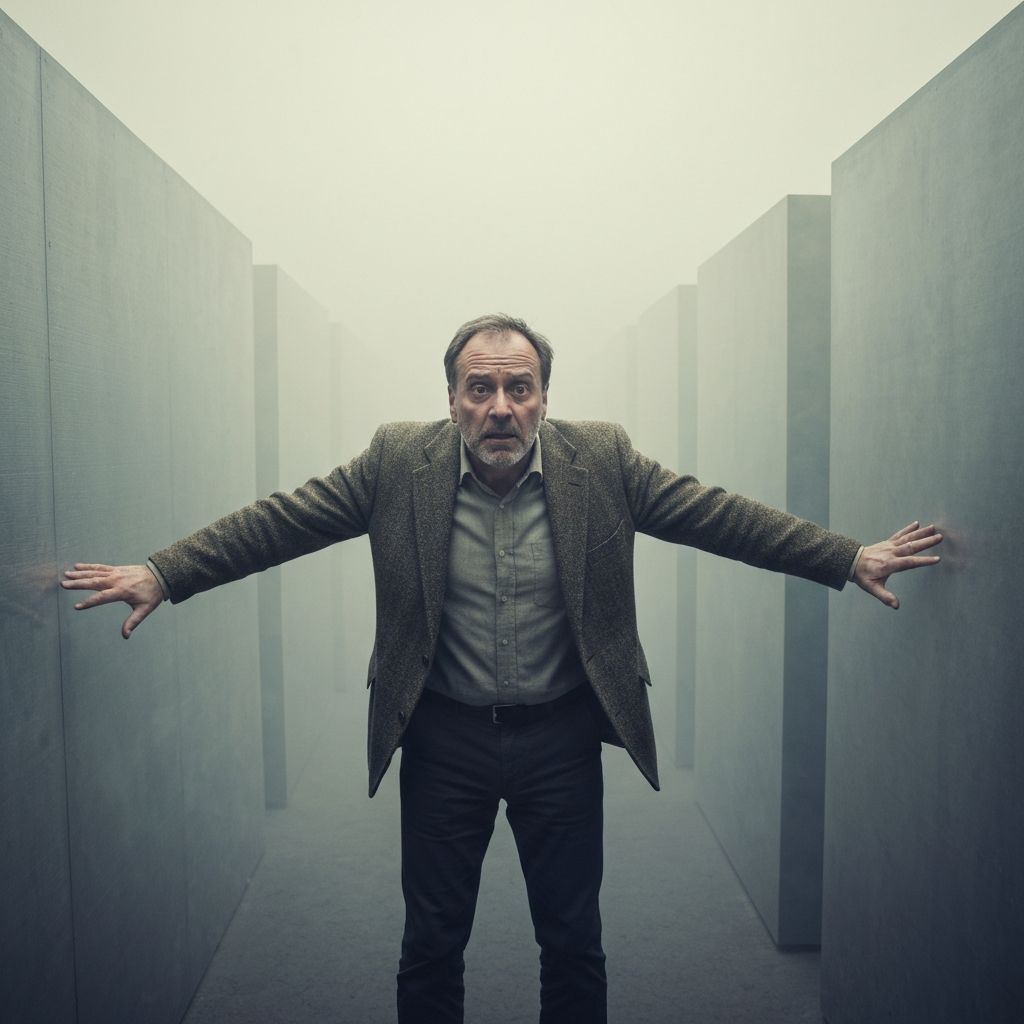
You are inside a building you have never seen before. The corridors stretch in directions that should not exist. Doors open onto rooms that lead to more doors. Staircases ascend to floors that were not there a moment ago. You are searching for the exit, for a familiar face, for any landmark, and finding none. This is the architectural anxiety dream, one of the most commonly reported dream scenarios worldwide, and one that reveals profound truths about how you navigate your inner psychological landscape.
Common Meanings
Dreams about being lost in buildings typically symbolize:
- Psychological complexity — the building represents your mind, and being lost reflects unfamiliarity with your own inner life
- Decision paralysis — too many doors, too many paths, and no clear way to choose
- Life-stage transitions — moving between chapters of life without knowing what comes next
- Career or identity confusion — not knowing where you fit within a larger structure
- Feeling trapped — being inside a system, institution, or relationship you cannot escape
- Undiscovered self — rooms you have never entered symbolize aspects of your personality you have yet to explore
Context Modifiers
Lost in a school or university: This dream typically surfaces when you feel tested, judged, or inadequately prepared. It may revisit actual school experiences as a metaphor for current situations where you feel like a student rather than an expert. Common during career changes, new job onboarding, or any period where imposter syndrome is active.
Lost in an office building: Your professional identity is in question. You may feel that your career has led you somewhere you do not recognize, or that the organizational structure around you has shifted in ways that leave you disoriented. Frequent among people navigating corporate restructuring, promotions that feel wrong, or the question of whether to stay or leave.
Lost in a hospital: Hospitals in dreams combine themes of vulnerability, healing, and institutional powerlessness. Being lost in one suggests that you are searching for a solution to an emotional or physical health concern but cannot find the right help, the right diagnosis, or the right person to trust. It can also surface when you are caretaking for someone and feeling overwhelmed by the medical system.
Lost in an unfamiliar mansion: Jung would call this the exploration of the Self. The mansion represents undiscovered dimensions of your personality — rooms you have never opened, floors you did not know existed. This dream is often less anxious and more curious in tone, appearing during periods of personal growth, therapy, or spiritual exploration. Each room holds something you are ready to discover.
Elevator going to the wrong floor: Elevators represent transitions between levels of consciousness or life stages. When the elevator ignores your button press and takes you somewhere unexpected, it reflects feeling that forces beyond your control are determining your direction. Common during involuntary life changes — layoffs, relocations, health diagnoses, or relationship endings you did not choose.
Psychological Lens
Carl Jung considered buildings in dreams to be among the most important symbols, representing the structure of the psyche itself. In his model, different floors correspond to different layers of consciousness: the basement houses the shadow and repressed material, the ground floor represents everyday conscious life, and upper floors access higher awareness, aspiration, and spiritual seeking. Being lost in a building, then, is literally being lost within yourself.
This interpretation gains support from modern research on spatial cognition during sleep. The hippocampus, the brain region responsible for navigation and spatial memory, is highly active during REM sleep. Dreams of navigating buildings may represent the brain attempting to construct cognitive maps of life situations that feel unmappable — the neural equivalent of trying to orient yourself within a problem that has no clear structure.
The internet phenomenon of "liminal spaces" — photographs of eerily empty pools, abandoned malls, and deserted hallways that evoke an unsettling familiarity — taps into exactly this dream experience. The viral appeal of liminal space content suggests that the feeling of being between places, between life stages, between identities, resonates deeply with a generation navigating unprecedented uncertainty. These images feel dreamlike because they are drawn from the same psychological well as the building dream itself.
Cultural Perspectives
- In Western architecture, buildings symbolize order, hierarchy, and civilization. Being lost in one subverts these associations and suggests that the structures of society — career ladders, institutions, social hierarchies — are failing to provide direction
- Feng shui traditions interpret buildings as extensions of the body and spirit. A building with confusing layout in a dream may indicate blocked energy flow (chi) in your physical or emotional life
- In mythological traditions, labyrinths and maze-like buildings appear from the Minotaur's labyrinth to Borges' Library of Babel, representing the human encounter with complexity that exceeds comprehension
- Modern urban psychology connects building dreams to the experience of navigating vast, impersonal spaces — airports, malls, hospital complexes — environments designed for efficiency that can feel dehumanizing to the individual
What to Do
- Map the building to your life. Ask which area — work, relationships, health, identity — feels like the building you are trapped in. The floor or wing often corresponds to a specific domain of confusion.
- Notice the doors. How many are there? Are they locked or open? Doors represent choices. If they are all locked, you may feel that no options are available. If there are too many, decision paralysis may be the issue.
- Consider what floor you are on. Basement dreams suggest buried emotions demanding attention. Top-floor dreams suggest aspirational confusion. The middle floors often relate to practical, everyday life decisions.
- Try active imagination. Revisit the building in waking meditation. Choose a door and open it. This Jungian technique can unlock insight that the dream's anxiety prevented you from accessing during sleep.
- Address real-world stuckness. These dreams respond powerfully to waking-life action. Make one decision you have been postponing, even a small one. The dream often resolves once movement begins.
- Journal the architecture. Sketch the building if you can. The layout often mirrors how you conceptualize your current life situation, and seeing it visually can reveal patterns you cannot access through words alone.
Related Dreams
- Being Lost — General dreams about being lost in any environment
- House Dreams — Dreams about houses as symbols of the self
- Elevator Dreams — Transitions and vertical movement in dream symbolism
- Stairs Dreams — Ascending and descending as life progress metaphors
Deeper Understanding
Explore our guide on Dream Architecture for a deeper look at how buildings and spaces function as dream symbols.
Learn about life-stage anxiety and how it shapes dream content in Dreams by Life Stage.
Disclaimer: Dream interpretation is subjective and for personal reflection only. This content provides psychological and symbolic perspectives, not medical or mental health advice. If anxiety significantly impacts your daily life, consult a qualified healthcare professional.
Frequently Asked Questions
Why do I keep dreaming about being lost in a large building?
Recurring dreams of being lost in large buildings typically reflect feeling stuck or directionless in a major area of your life. The building represents your internal psychological landscape, and being unable to find your way suggests confusion about identity, career direction, or life-stage transitions.
What does it mean to dream about endless hallways with no exit?
Endless hallways symbolize feeling trapped in a situation with no clear resolution. You may be stuck in a repetitive routine, a stagnant relationship, or a career path that feels like it leads nowhere. The absence of an exit reflects decision paralysis or a belief that no good options exist.
Is there a difference between being lost in a school versus an office building in a dream?
Yes. Being lost in a school points to unfinished learning, past insecurities, or feeling tested. Being lost in an office building connects to career confusion and professional identity. A hospital suggests health anxiety or emotional healing, while an unfamiliar mansion relates to undiscovered aspects of your personality.
What are liminal space dreams?
Liminal space dreams feature eerily empty, transitional places like vacant hallways, empty malls, and deserted stairwells. They reflect being between life stages — not where you were, but not yet where you are going. The internet aesthetic of liminal spaces resonates because it captures this universal psychological experience.
What should I do if I have architectural anxiety dreams?
Map the building to your life. Which area feels like the floor you are stuck on? Consider what exit you are searching for in waking life. These dreams respond well to active imagination techniques — revisit the dream in meditation and choose a door to open.