
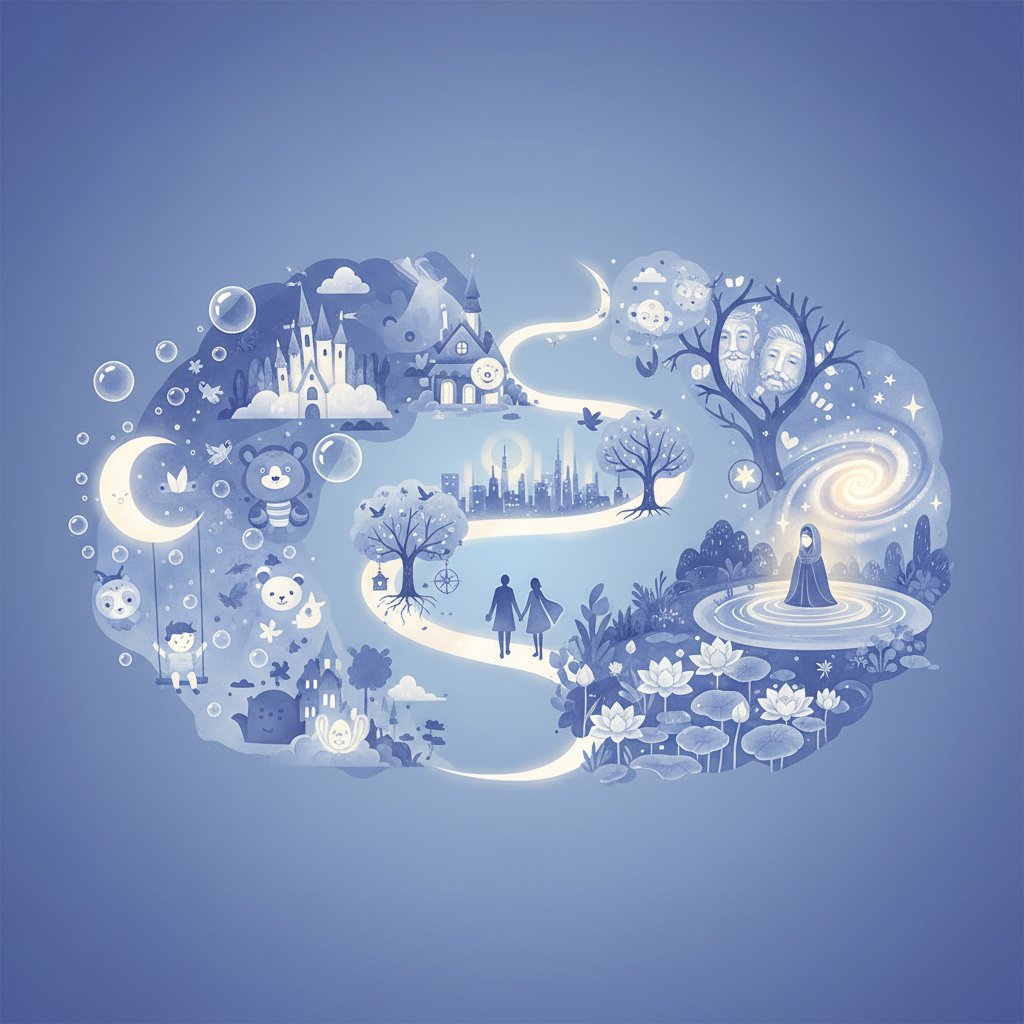
Your dreams at fifteen are nothing like your dreams at fifty — and there's a reason for that. Dream content tracks remarkably closely with the psychological tasks of each life stage. Understanding this pattern transforms dream interpretation from guesswork into a developmental map of your inner life.
This guide organizes dream symbolism by the life stage you're actually living, drawing on developmental psychology research from Erik Erikson's stages to modern sleep studies by Dr. Tore Nielsen and Dr. Deirdre Barrett.
Why Dreams Change With Age
Dream content isn't random. Research published in Frontiers in Neurology demonstrates that both dream recall frequency and thematic diversity shift predictably across the lifespan. Dream recall peaks in your twenties, declines through middle age, and the emotional intensity of dreams shifts from anxiety-dominant (youth) to reflective and integrative (later life).
The explanation is straightforward: your dreams process what your waking life demands. And those demands change dramatically as you move through life.
Teens and Adolescence (13-19): Identity Formation
Signature Dreams
Adolescent dreams are dominated by themes of social exposure, testing, and pursuit:
- Being chased — the most common teen dream, reflecting the constant pressure of social evaluation and identity formation
- Exam and school dreams — anxiety about performance, being judged, or not measuring up
- Flying and supernatural powers — the adolescent fantasy of transcendence, escaping limitations
- Nakedness in public — vulnerability, fear of being seen as you really are before you've decided who that is
- Teeth falling out — loss of control during a period when everything is changing without your permission
What's Happening Psychologically
Erik Erikson identified adolescence as the stage of "Identity vs. Role Confusion." Teens are building a self from scratch, which is terrifying. Their dreams reflect this construction project — the fear of getting it wrong, the exhilaration of new capabilities, the raw vulnerability of not yet having a stable identity to retreat to.
Dream Journal Prompt
If you're a teen: What are you most afraid other people will discover about you? Your chase dreams and nakedness dreams are usually about that.
Young Adults (20-30): Expansion and Exposure
Signature Dreams
Young adult dreams shift toward navigation, exposure, and relational complexity:
- Flying — the most positively experienced dream, peaking in the twenties. Reflects the expansion of possibility and new freedom
- Being naked or underdressed — persists from adolescence but evolves. Now it's less about identity and more about professional or social inadequacy
- Being late or missing transportation — anxiety about keeping up, missing opportunities, the relentless pace of early career life
- Relationship dreams — romantic partners, exes, complicated social dynamics. The dreaming mind processes attachment patterns intensely during the period when pair-bonding is most active
- Water dreams — oceans, floods, swimming. Water symbolizes emotion, and young adults are navigating deeper emotional waters than ever before
What's Happening Psychologically
Erikson called this the stage of "Intimacy vs. Isolation." Young adults are learning to merge their newly formed identity with others — in love, in friendship, in professional collaboration. Dreams become more emotionally complex, featuring more characters and more nuanced social scenarios than at any other life stage.
Research by Dr. Michael Schredl shows that dream recall frequency peaks between ages 20-29, meaning this is the life stage where you are most likely to remember and be affected by your dreams.
Dream Journal Prompt
If you're in your twenties: What opportunity are you most afraid of missing? Your 'running late' and transportation dreams are tracking that anxiety.
New Parents (Any Age): Overwhelm and Responsibility
Signature Dreams
Parenthood introduces a distinct dream signature regardless of the parent's age:
- Water and flooding — emotional overwhelm, feeling submerged by new responsibility
- Baby dreams — forgetting the baby, losing the baby, the baby talking or being unexpectedly capable. These are normal anxiety-processing dreams, not premonitions
- House dreams — discovering new rooms, houses falling apart. The house represents your life structure, which is being fundamentally redesigned
- Animal dreams — nurturing, protecting, or being overwhelmed by dependent creatures
- Teeth falling out — resurfaces during parenthood as a symbol of losing control over your own body and schedule
What's Happening Psychologically
Parenthood is the most dramatic identity shift most people experience. Your dreaming mind works overtime to integrate the new role, process the sleep deprivation (which paradoxically increases dream intensity during the sleep you do get), and rehearse threat scenarios to keep your child safe. Dreams of forgetting or losing your baby are nearly universal and reflect the weight of the responsibility, not any inadequacy.
Dream Journal Prompt
If you're a new parent: What aspect of your pre-parent identity do you miss most? Your 'discovering new rooms' dreams may be about finding space for that part of yourself.
Midlife (40-55): Reflection and Reorientation
Signature Dreams
Midlife dreams shift toward architecture, journeys, and self-examination:
- House dreams — exploring large, complex houses with many rooms. Represents the accumulated life you've built and the rooms (aspects of self) you haven't visited in years
- Journey and travel dreams — roads, trains, airports. The question is no longer "who am I?" but "where am I going with the time I have left?"
- Former workplaces or schools — revisiting past environments, re-evaluating past choices
- Deceased parents or mentors — processing grief, seeking wisdom, confronting mortality through those who went before you
- Driving dreams — being in the driver's seat (or not), losing control of the vehicle. Direct metaphors for life direction
What's Happening Psychologically
Jung considered midlife the most important period for psychological development — the point where the ego must begin integrating the shadow (repressed aspects of self) to achieve wholeness. Midlife dreams are often described as "deeper" and more symbolically rich than earlier dreams because the psyche is drawing on decades of accumulated experience.
Research from the Washington Post's 2024 review of dream studies confirms that midlife dreamers report fewer nightmares but more emotionally complex dreams — the terror decreases while the nuance increases.
Dream Journal Prompt
If you're in midlife: Which room in your dream house have you been avoiding? That room contains something you put away decades ago that's ready to be reclaimed.
Later Life (60+): Integration and Transcendence
Signature Dreams
Dreams in later life become increasingly integrative, spiritual, and relational:
- Departed loved ones — the most distinctive feature of elder dreams. Visits from deceased family members and friends that often feel qualitatively different from regular dreams — more peaceful, more vivid, more meaningful
- Landscape dreams — vast natural scenes, gardens, oceans. The psyche contemplates the larger picture
- Childhood settings — returning to early life environments. The circle of memory closes as the mind revisits its origins
- Light and luminosity — dreams become literally brighter for many older adults, featuring more light imagery
- Travel to unknown destinations — not anxious like young adult travel dreams, but curious and exploratory
What's Happening Psychologically
Erikson's final stage is "Integrity vs. Despair" — the task of making peace with the life you've lived. Research by Dr. Josie Malinowski shows that older adults report fewer anxiety dreams and more positive dream content, suggesting that the dreaming mind, like the waking mind, shifts toward acceptance and integration with age.
The prevalence of visitation dreams (dreams of deceased loved ones) is particularly noteworthy. Whether interpreted psychologically as memory integration or spiritually as genuine contact, these dreams are consistently described as deeply comforting and meaningful.
Dream Journal Prompt
If you're in later life: Who has visited you in your dreams recently? What did they communicate — through words, feeling, or presence?
Life Events That Override Age Patterns
Certain life events create their own dream signatures regardless of your age:
- Grief — deceased persons, searching dreams, empty houses
- Divorce or breakup — ex-partner dreams, being lost, natural disasters
- Job loss or career change — exam dreams return, being unprepared, showing up to the wrong place
- Moving or relocation — lost in unfamiliar places, old home appearing in new contexts
- Illness or health crisis — body dreams, medical settings, transformation imagery
Practical Strategies Across All Stages
Before Sleep
- Reflect on your current life stage challenge — name it specifically
- Ask your dreaming mind a question related to that challenge
- Keep a journal and pen within arm's reach
After Waking
- Write down your dream within five minutes — details fade fast
- Identify the life stage signature: is this an identity dream, an expansion dream, a reflection dream?
- Ask: what developmental task is my dream helping me process?
- Notice recurring symbols — they point to your most active psychological work
Ongoing Practice
- Review your dream journal monthly to spot patterns
- Notice when your dream themes shift — it often signals a life transition before your conscious mind catches up
- Share dreams with a trusted person. Speaking dreams aloud often reveals their meaning more effectively than silent analysis
For more on specific dream symbols, explore our dream symbols dictionary. For recurring patterns, see our recurring dream patterns guide.