
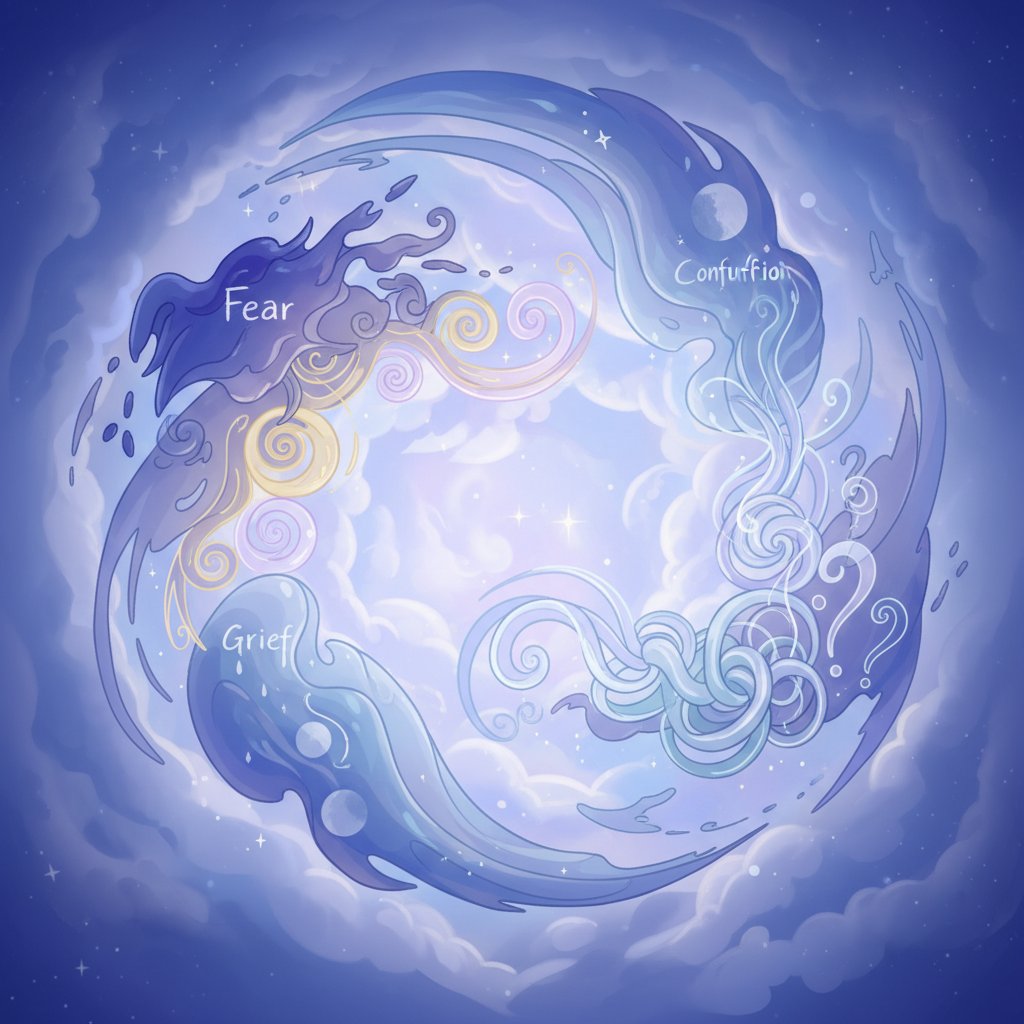
Most dream dictionaries work backwards. They ask you to remember a symbol — a snake, a house, a car — and then tell you what it means. But that is not how you actually experience dreams. You wake up and the first thing that hits you is the feeling: dread, elation, confusion, grief. The imagery comes second.
This guide inverts the standard approach. Start with the emotion you felt during or immediately after the dream, then use it as a compass to decode the symbols that appeared. Dream researcher Ernest Hartmann called dreams "picture-metaphors for the dreamer's most prominent emotion" — so the feeling is not just context, it is the key.
Fear and Anxiety
Fear is the most commonly reported dream emotion, appearing in roughly 70% of recalled dreams according to sleep research. When fear dominates your dream, your amygdala is running threat simulations — rehearsing danger responses to keep you safe.
Symbols That Carry Fear
- Being chased — the most universal fear dream, representing avoidance of a confrontation or truth you are not ready to face
- Falling — loss of control, instability, the ground literally disappearing beneath your sense of security
- Crocodiles and snakes — primal predators that activate your reptilian brain, representing hidden threats and deception
- Teeth falling out — anxiety about appearance, communication, or losing something you cannot replace
- Drowning — emotional overwhelm, the feeling that your circumstances are literally pulling you under
- Being trapped — claustrophobia in waking life, whether in a job, relationship, or pattern you cannot escape
What Fear Dreams Are Telling You
Your brain is not torturing you — it is training you. The Threat Simulation Theory suggests that fear dreams evolved to rehearse survival responses. Ask yourself: what am I avoiding in waking life that my sleeping brain is forcing me to practice confronting?
Loss and Grief
Dreams saturated with sadness, grief, or longing often process losses you have not fully metabolized — whether recent or years old. The sleeping brain has no timeline; it revisits loss when it needs to.
Symbols That Carry Loss
- Dead person appearing — unfinished emotional business with someone who has passed, or the death of a phase of your life
- Ex-partner — not necessarily about the person, but about what they represented: security, youth, a version of yourself you miss
- Hair falling out — loss of vitality, identity, or attractiveness — grief for a former self
- Water (especially flooding or storms) — emotional processing overflowing its banks, grief demanding expression
- Lost or searching — a sense that something essential has been misplaced in your life, a direction you have lost
What Grief Dreams Are Telling You
These dreams are not setbacks — they are processing. Your brain is doing grief work that your waking hours may not allow space for. Consider keeping a dream journal during periods of loss; the dreams often contain messages of resolution your conscious mind is not yet ready to hear.
Confusion and Disorientation
That feeling of being in a place that is familiar yet wrong, of rules that keep shifting, of knowing you have somewhere to be but not where — confusion dreams reflect cognitive overwhelm and identity uncertainty.
Symbols That Carry Confusion
- Exam dreams — being tested on material you never studied, representing imposter syndrome or feeling judged by standards you do not understand
- Mirrors — seeing a distorted or unfamiliar reflection, questioning who you really are versus who you present to the world
- House with unknown rooms — discovering parts of yourself you did not know existed, psychic architecture shifting
- Driving without knowing where — life direction unclear, decision fatigue, autopilot living
- Being invisible — feeling unseen or irrelevant, questioning whether your presence matters
What Confusion Dreams Are Telling You
Confusion dreams peak during identity transitions: career changes, aging milestones, cultural shifts. They are your brain rebuilding its internal map. The confusion itself is not the problem — it is the symptom of a map being redrawn. Give yourself permission to not have all the answers right now.
Empowerment and Joy
Not all significant dreams are dark. Dreams of flying, mastery, or profound peace carry just as much diagnostic weight — they reveal what your subconscious believes you are capable of, often before your waking mind catches up.
Symbols That Carry Empowerment
- Flying — liberation, transcendence above problems, accessing a perspective your ground-level life does not provide
- Swimming confidently — emotional fluency, navigating feelings with skill and grace
- Fire (controlled) — passion, transformation, creative energy channeled constructively
- Wedding — integration and union, committing to a new chapter or merging different parts of yourself
- Pregnancy and baby — new creation, something gestating in your life that has not yet been born but is growing
What Empowerment Dreams Are Telling You
Take these dreams seriously. Your subconscious is showing you a version of yourself that is already present but not yet fully expressed. These are not escapist fantasies — they are blueprints. The confidence you felt in the dream is real; it lives in you during waking hours too.
Shame and Vulnerability
Dreams drenched in embarrassment, exposure, or inadequacy often process social anxiety and self-judgment. They tend to feel so viscerally real that the shame lingers long after waking.
Symbols That Carry Shame
- Nakedness — feeling exposed, fear of being seen as you truly are without social armor
- Being late — fear of failing to meet expectations, letting people down, running out of time
- Cheating (being cheated on or cheating) — trust violations, guilt about desires, or fear of betrayal
- Teeth falling out — also maps to shame about appearance and social judgment
- Exam unprepared — performance anxiety, feeling like a fraud
What Shame Dreams Are Telling You
Shame dreams often reveal the gap between your authentic self and the self you perform for others. They are not evidence that you are inadequate — they are evidence that you care deeply about how you show up. Consider what standard you are holding yourself to, and whether that standard is truly yours or inherited.
How to Use This Guide
- When you wake up, name the emotion first — before reaching for a dream dictionary or trying to recall symbols, sit with the feeling for 30 seconds
- Find your emotion section above — then scan the symbols listed. Which ones appeared in your dream?
- Read the linked dream article — each symbol page contains scenario-specific modifiers that add nuance to your interpretation
- Cross-reference emotions — many dreams carry multiple emotions simultaneously. A flying dream that turns into a falling dream moves from empowerment to fear, mapping a waking-life shift from confidence to anxiety
- Track patterns over time — use a dream journal to record both the emotion and the symbols. Over weeks, you will notice your subconscious has themes, and those themes map directly to the work your psyche is doing
- Explore our full dream symbols dictionary — once you have identified the emotion, use the dictionary for symbol-specific depth
- Read about recurring dream patterns — if the same emotion keeps appearing across multiple dreams, your subconscious has an unresolved thread that deserves attention